
EV Charger Installation Service
A standard wall outlet adds about 3 to 5 miles of range per hour, and EV charger installation turns that into a full battery by morning. Wired SC handles electric vehicle charger installation for homeowners. Our license number is M115240. That wall outlet is a 120 volt Level 1 connection, the slow portable cord many cars come with. A Level 2 charger runs on 240 volts and adds about 20 to 40 miles of range per hour. The exact rate depends on the charger and on the car’s onboard charger, which caps how fast the battery takes power. Every install follows NEC Article 625, the code article for electric vehicle charging equipment. It requires a dedicated circuit for each charger and GFCI protection on charger outlets.
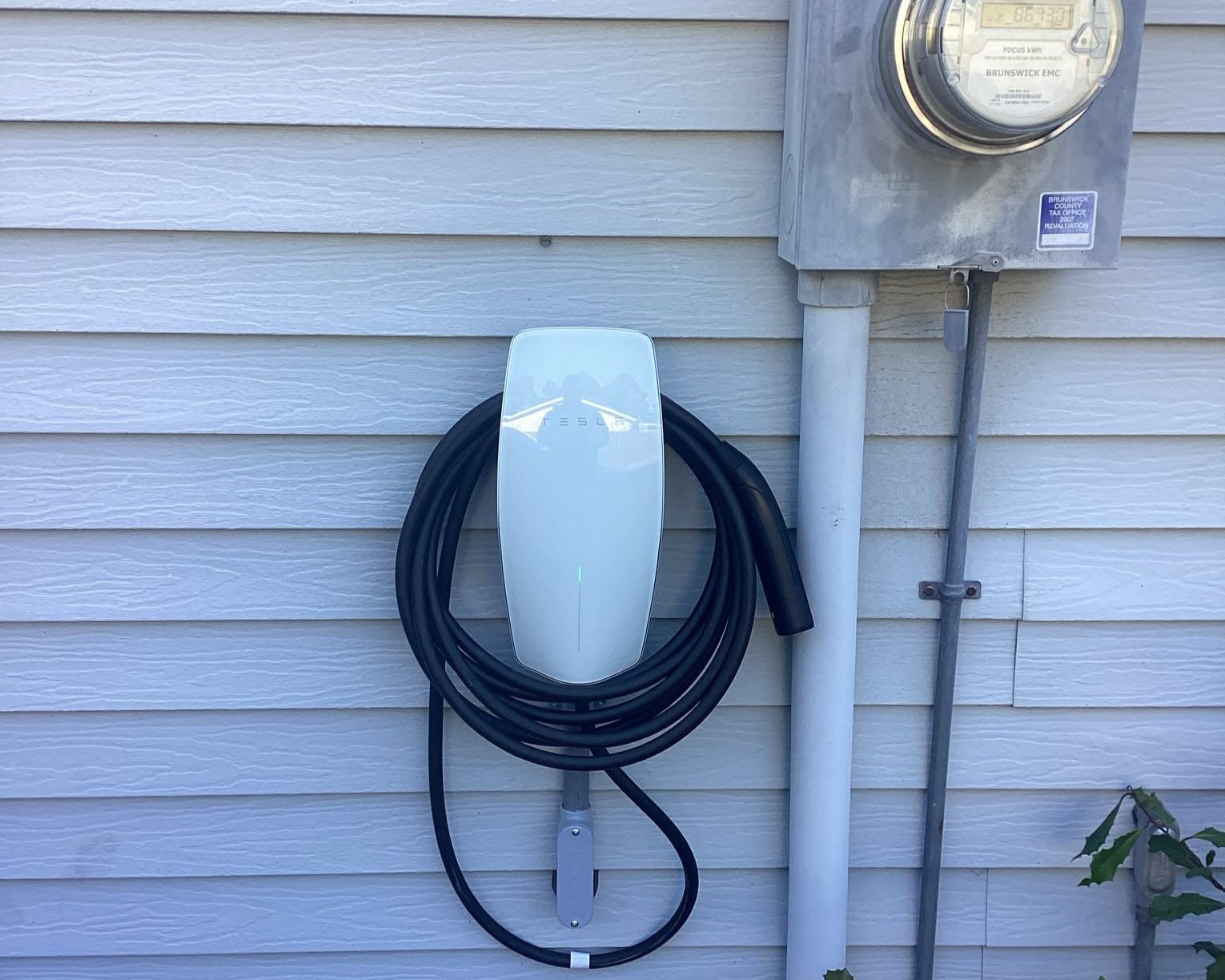
Tesla And Level 2 EV Charger Installation With The Right Breaker Size
Wired SC wires every Tesla and Level 2 EV charger installation around one code rule. The NEC treats EV charging as a continuous load, so the circuit has to be rated at 125 percent of the charger’s draw. The Tesla Wall Connector pulls 48 amps, so Wired SC puts it on a 60 amp breaker. Other 48 amp Level 2 chargers get the same 60 amp circuit. Wire size follows the breaker, and a 60 amp circuit runs on 6 AWG copper in conduit. The Wall Connector is a hardwired wall charger, so it connects straight to the circuit. Plug in chargers use a NEMA 14-50 outlet, which tops out at 40 amps of charging. Wired SC mounts every charger close to where you park, so the cable reaches the charge port with no strain.
EV Home Charger Installation Without Overloading Your Panel
Your electrical panel sets the limit for any EV home charger installation. Wired SC runs a load calculation under NEC Article 220 before choosing a breaker. The calculation adds up your HVAC, water heater, range, dryer, and the new charger. A house with 200 amp service has room for a 48 amp charger in most cases. An older house with 100 amp service has less room. The panel also needs two open breaker spaces for the new 240 volt circuit. Three fixes keep the panel from overloading. The charger’s amp limit gets set lower, which NEC 625.42 allows. An energy management device pauses charging when the house pulls heavy power. A panel upgrade adds capacity when the first two fall short. We explain each option and its tradeoff before any work starts.
What Do You Need From Me Before EV Charger Installation?
Tell us your panel size, your car model, the charger you plan to use, and where you park. Those answers show us the breaker size, the wire run, and whether the panel needs help first. Wired SC has worked with homeowners since 2017, and our phone line is open 24 hours a day, 7 days a week.
Already bought a charger? Call 843-492-5000 with the model and its amp rating. A licensed EV charger installer from Wired SC plans the circuit around it.
Still shopping for one? Fill out the form below with your car model and your main breaker size. We match the charger amp rating to your car and your panel.
Frequently Asked Questions
Can You Install A Tesla Wall Connector In My Garage?
Yes. Wired SC installs Tesla Wall Connectors on a dedicated circuit in your garage. During setup, the Wall Connector’s current limit gets set to match the breaker. That step keeps the charger from pulling more than the circuit allows. The Wall Connector also joins your home network, so it gets firmware updates on its own. It uses the NACS plug, now known as SAE J3400.
Do I Need A Permit To Install An EV Charger?
Yes. A hardwired charger or a new 240 volt circuit needs an electrical permit in most areas, and Wired SC installs each charger to pass the inspection that follows. The inspector checks the breaker size, wire gauge, GFCI protection, and grounding under NEC Article 625. A permit also gives you a clean record when you sell the house.
Which EV Charger Plug Works With My Car?
Your car uses one of two plugs, J1772 or NACS. Wired SC installs chargers with either plug, so the charger matches your car. NACS, now standardized as SAE J3400, started with Tesla and is spreading to other automakers. Many older non Tesla models use J1772. An adapter connects one plug type to the other for home charging.
How Long Does EV Charger Installation Take?
Two to four hours for most installs where the charger mounts near the panel. Wired SC plans the time around your wire run and your panel. A long run through finished walls adds time. A panel upgrade turns the job into a full day or more. Permit approval and the final inspection add time before and after the install.
Why Do I Need An Electrician To Install An EV Charger?
An EV charger pulls more steady power than almost anything else in your house. Wired SC is a licensed electrician, and the job needs that license for the electrical permit. A 48 amp charger runs at full load for hours every night. Undersized wire or a loose lug heats up under that load. Correct breaker sizing, torqued terminals, and GFCI protection keep the circuit cool and safe.
Who Installs EV Chargers Near Me?
A licensed electrician installs EV chargers. Wired SC is an EV charger installer for homeowners, and our phone line is open 24 hours a day, 7 days a week. We handle Level 2 chargers, Tesla Wall Connectors, and the panel work behind them. Call 843-492-5000 to set up your install.
Is A Level 2 Charger Worth It If I Drive Under 40 Miles A Day?
Not always. Wired SC tells drivers when a standard outlet already covers their miles. A 120 volt Level 1 cord adds about 30 to 50 miles over a 10 hour night. That covers a short daily commute. A Level 2 charger pays off for longer drives, two EVs in one house, or cold mornings when the battery needs more energy.
What Your Neighbors Are Saying About Us
Areas We Serve

Myrtle Beach
Ocean Isle Beach
Georgetown
Conway
Pawleys Island
Sunset Beach
Murrells Inlet
Little River
Surfside Beach
North Myrtle Beach
Socastee